
As an Amazon Associate we earn from qualifying purchases.
Last October I left the house at 7:15 in a wool coat, gloves in my pocket, breath visible in the driveway. By 12:40 I was standing in full sun with that coat folded over my arm, sweating through a sweater I could not take off because there was nothing acceptable underneath it. Same day, same city, same body. The temperature moved about twenty-two degrees and I had dressed for exactly one of those numbers.
Owning more clothes does not fix that. Understanding what your clothes are physically doing does: where warmth comes from, where it leaves, and which fabrics move air and which trap it. Once you know the mechanism, you stop guessing at the forecast.

Why layering works
Here is the most useful thing I can tell you about staying warm: the fabric is not the insulator. The air is.
Wool, down, fleece, and cashmere do not keep you warm because the fiber is warm. They keep you warm because they hold still air in place, and air conducts heat poorly. Your body constantly warms the air against your skin. If that air stays put, you feel warm. If it is swept away and replaced with cold air, you feel cold. Every insulating garment is a scaffold for holding still air against you.
That one fact explains almost everything counterintuitive about cold weather dressing. Three thin layers usually beat one thick one because you have three separate pockets of trapped air instead of one, and each boundary is another place heat has to slow down and cross. A thick sweater gives you one thermal zone. A thin knit, a shirt, and a jacket give you three, plus the option to remove one when the building’s heat kicks on.
It also explains the mistake I see most: layering things tight. A snug long sleeve under a fitted sweater under a coat that barely closes has squeezed all that air out of the system. Compressed insulation is not insulation, it is just fabric. Someone in three tight layers can genuinely be colder than someone in one loose sweater with room to breathe.
The other half is moisture. Water conducts heat far better than air, which is excellent when you want to cool down and miserable when you do not. A layer damp with sweat has replaced your insulating air with something that pulls heat off your skin. That is why a cotton undershirt wrecks a cold walk after you hustle for a train.
So the whole game is this. Trap still air, keep it dry, control how much escapes.
The three layer jobs
Outdoor gear people have used a base, middle, outer framework for decades, and it translates cleanly to regular clothes. It tells you what each piece is responsible for, so you stop asking one garment to do three jobs badly.
The base layer: manage moisture
The base sits against skin and its job is not warmth. Its job is moving sweat away before that sweat starts conducting heat out of you. It should fit close, since it needs skin contact to wick, but close is not compressive. Fine merino, silk, and performance knits belong here. Merino is my default because it moves moisture while still insulating when slightly damp.
The mistake: a cotton tee as your base in cold weather. Cotton holds many times its weight in water and gives it up slowly, which is why you feel clammy and then chilled the moment you stop moving.
The middle layer: trap air
This is where warmth actually lives. The middle layer needs loft: structure that holds air without collapsing. Wool and cashmere knits, fleece, brushed flannel, a quilted vest. Texture is a visual cue for loft.
The mistake: sizing it too close. If your cardigan grips the layer under it, you have removed the air gap and now have one layer’s worth of warmth while wearing two layers’ worth of clothing. It should skim, not cling.
The outer layer: block wind
The outer layer stops your trapped air from being stolen, and wind is the thief. A breeze does not lower the temperature, but it strips away the warm air your body spent energy heating and replaces it continuously, which is why a thirty-eight degree day with wind feels worse than a thirty degree day without it. Anything woven densely enough that air cannot pour through belongs here, and it need not be thick: a thin windproof shell over a lofty sweater beats a loose-knit coat with nothing under it.
The mistake: buying the outer layer to fit your body rather than your system. A coat that looks right over a thin top in the fitting room cannot go over a sweater in January. Try coats on over the thickest thing you plan to wear under them. This is where most fall outfit ideas for women quietly succeed or fail.
Dressing for heat
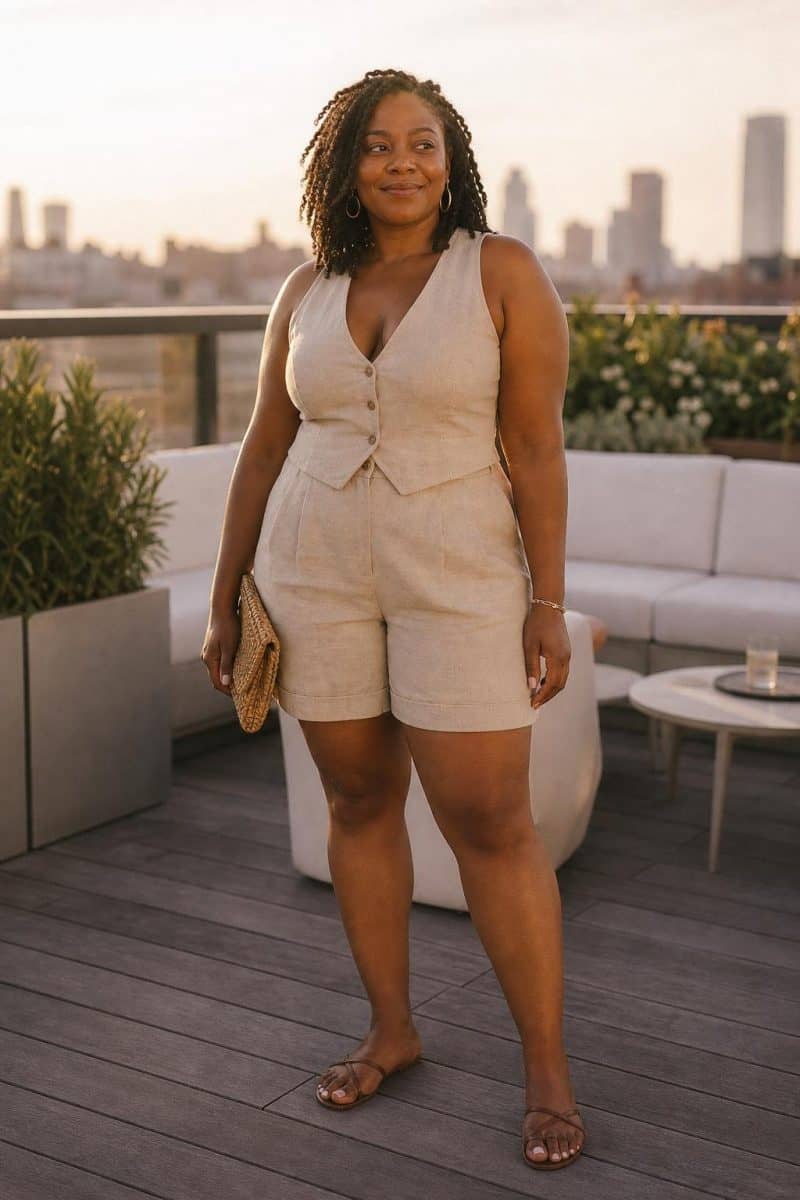
Cooling off runs on the opposite principle. Instead of trapping still air you want air moving across skin, because moving air carries away both heat and the sweat that cools you as it evaporates. Evaporation is your strongest cooling tool, and clothing either helps it or blocks it.
That is why loose beats tight in heat, and it is not close. Space between fabric and skin creates a chimney: warm air rises out at the neckline while cooler air is drawn in at the hem and sleeves, and every step pumps air through the gap. A tight top has no gap, so it holds sweat against you and stalls evaporation. The best casual summer outfits follow this whether or not anyone says so.
Now the part that sounds wrong. In direct sun, a light long sleeve can be cooler than a bare arm. Bare skin absorbs solar radiation directly, while a loose opaque sleeve intercepts it, shades the skin, and still lets air move underneath. The sleeve has to be loose and breathable, and it has to be real sun; indoors, a bare arm wins. At two in the afternoon a floaty long sleeve is a strategy, and it runs quietly through a lot of summer outfits for hot weather.
Weave matters more than fiber content here. You want open structure and low contact with skin. Linen wins on both: the fibers are stiff enough that the fabric stands off the body instead of clinging, and the weave passes air. Cotton voile, gauze, seersucker, and open-knit cotton work the same way. Lining is the silent killer of a summer dress, because it doubles the fabric and closes off airflow.
Color matters less than people insist. Black absorbs more solar radiation than white, but in loose clothing much of that heat radiates back outward and blows away before reaching you, and dark fabric blocks more sun from reaching skin. The gap between a loose black linen shirt and a loose white one is small. The gap between a loose shirt and a tight one is large. That is the idea hiding inside most cute summer outfit ideas.
Dressing for cold
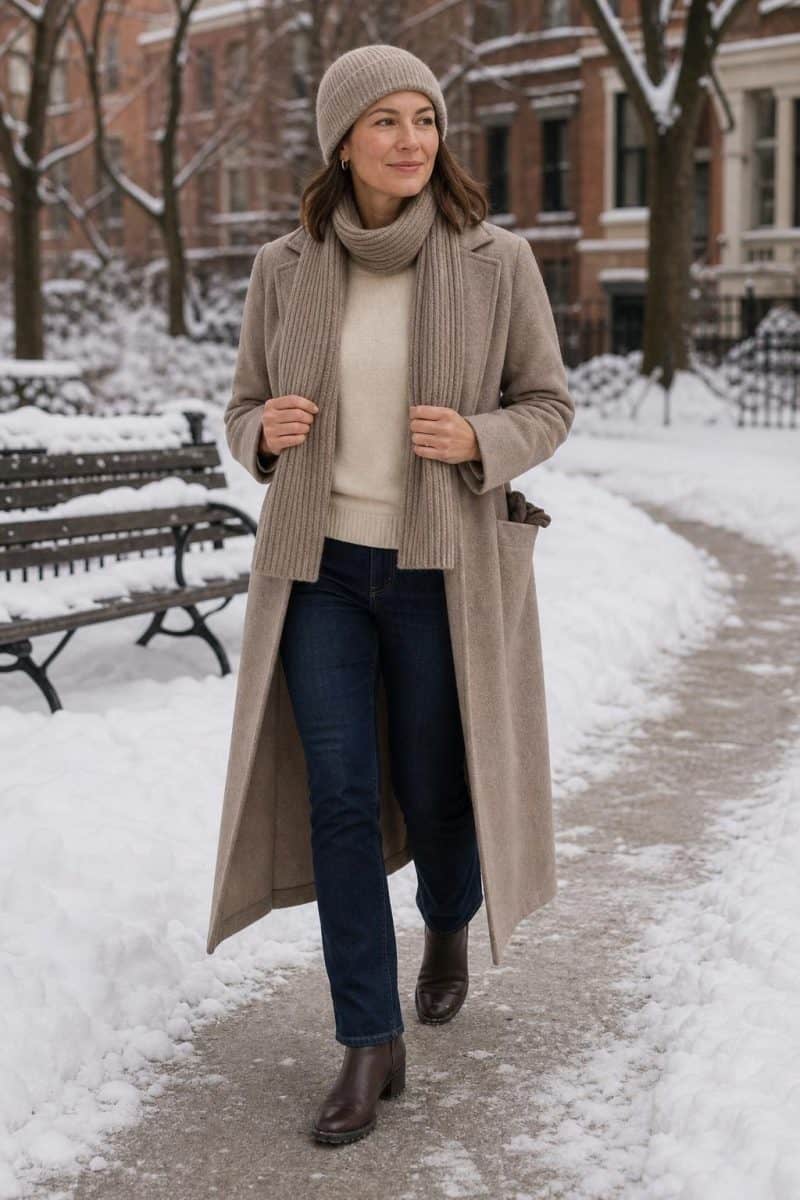
You lose heat four ways: conduction, convection, radiation from exposed skin, and evaporation. Cold dressing means closing off the first three without triggering the fourth by overdressing and sweating into your base layer.
The head is not the mythical fifty percent, though it loses heat fast for its size because it is usually the one thing uncovered. The more useful insight is the spots people ignore: wrists, ankles, and neck. Blood runs close to the surface at all three, so air passing over them cools blood heading straight back to your core. They are also where garments leave gaps.
Fixing them takes almost no effort and pays off out of proportion. A scarf is not an accessory in January, it is a seal on the biggest air leak in your outfit: the coat opening at your neck, where warm air escapes every time you move. Sleeves that reach the wrist bone keep that vein off cold air, and socks that clear your boot tops close the ankle. I changed nothing about my coat and made a winter commute tolerable this way. It is the difference between cozy fall outfits that feel cozy outdoors and ones that only look it.
Then there is the coat that will not close over your sweater. The instinct is to squeeze into it, which is the worst option, because you crush the sweater’s loft and lose the warmth you were adding. Better moves:
- Swap bulk for density. A thin, dense merino knit can rival a chunky sweater at a fraction of the volume, because fine tight wool traps air in the fiber structure rather than between yarns.
- Move warmth off the sleeves. A vest under the coat adds core warmth with no arm bulk, and arms are where coats bind first.
- Layer over the coat instead of under it. A large scarf or a long cardigan on top adds a wind barrier without fighting the coat’s cut.
- Warm the extremities harder. Better gloves and a hat let you get away with less torso insulation, since your body restricts blood flow to cold hands and feet, which is what makes you feel chilled all over.
- Accept that a fitted wool coat is a shoulder season coat. One garment cannot span forty degrees.
The other cold weather trap is dressing for outdoors and forgetting indoors. If your day includes a heated office you need to shed down to something presentable, which is where a cardigan beats a pullover and where the thinking behind good work outfits for women also makes good winter ones. The same holds at the relaxed end of the season, where casual fall outfit ideas lean on open layers.
The shoulder seasons

Spring and fall are harder than either extreme. In January you dress for cold and you are done. In late September you dress for a forty-eight degree morning, a seventy-one degree afternoon, and a fifty-four degree walk to the car, and no single outfit is right for all three.
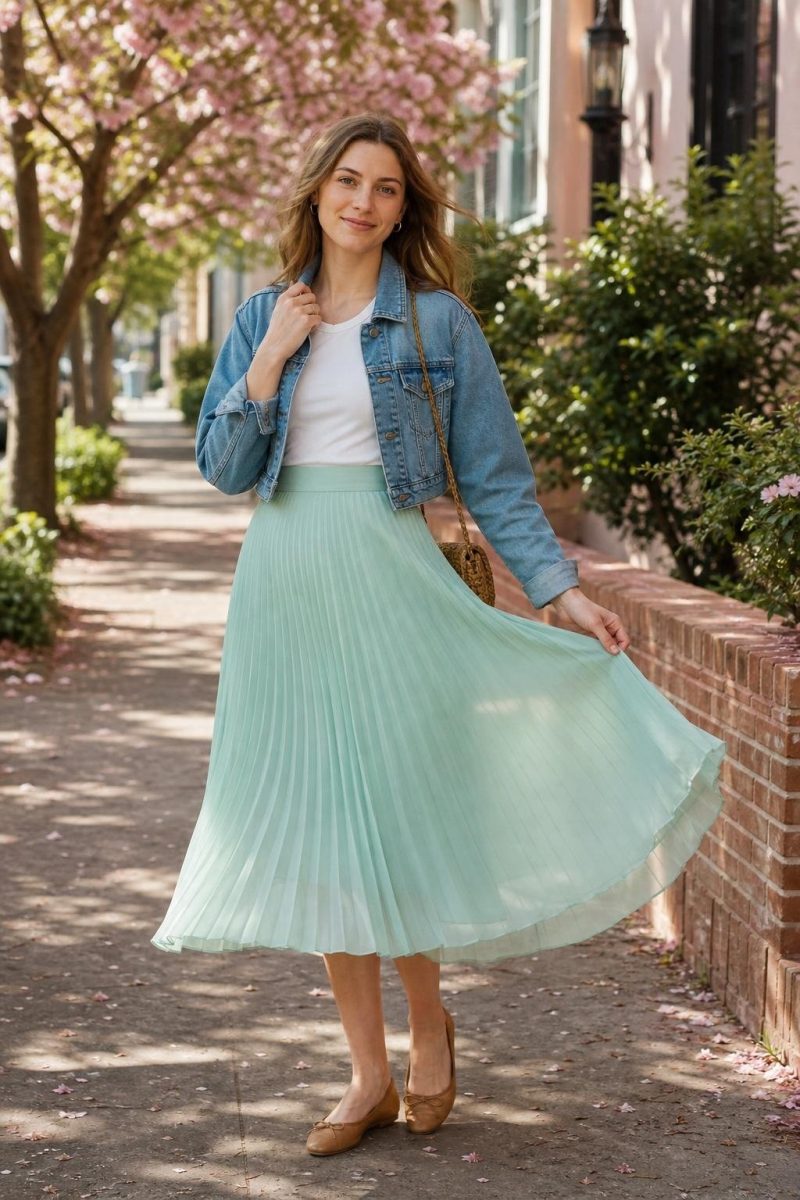
Build the outfit as a base that suits the warmest part of the day, plus a removable layer for the coldest part. Most people do the reverse, dressing for the morning and overheating all afternoon because the outfit does not work without its layers. If the top layer comes off and what remains is unwearable, you have built a winter outfit with a bad exit strategy. Every good summer to fall transition outfit is built the other way: a warm weather core with one thing over it.
Which means the removable layer has to compress. A fine knit cardigan, an unlined jacket, a large scarf, a light overshirt: all fold down small. A structured wool coat does not fold at all. And you need somewhere to put it, so the bag is part of the outfit in shoulder season, because a layer you cannot carry is a layer you keep wearing while sweating. Anyone who has assembled airport outfits for fall travel already knows it.
The fabrics that span a range handle both moisture and mild insulation. Merino stands out because it insulates when cool and releases moisture when you warm up. Cotton poplin, silk, lighter denim, and mid-weight knits sit comfortably across a twenty degree swing. Heavy flannel, thick fleece, and anything lined do not, and neither does pure linen, which sheds heat so efficiently that it turns cold the moment the sun drops. That is why late summer outfits pull in cotton and knits while the highs still say summer.
A fabric table
| Fabric | Warmth | Breathability | Best Season | Watch Out For |
|---|---|---|---|---|
| Cotton jersey | Low | Good when loose, poor when damp | Spring, summer, indoor layering | Holds sweat and stays wet, so it is a weak base layer in cold |
| Linen | Very low | Excellent, the most air-permeable common weave | Peak summer | Goes cold fast after sunset; wrinkles are structural |
| Cotton poplin | Low to moderate | Moderate, depends on weave density | Spring and fall, year round for shirting | Tight weaves block airflow more than the light hand suggests |
| Merino wool | Moderate to high for its weight | Excellent, moves moisture while insulating | All four, weight depending | Fine knits abrade at bag straps and elbows |
| Cashmere | High | Moderate | Fall and winter | Pills under friction; loses loft if stored compressed |
| Wool flannel | High | Moderate, blocks wind well | Deep winter | Too warm indoors; heavy and slow to dry once wet |
| Denim | Moderate, mostly wind resistance | Low | Fall and spring | Miserable when soaked; heavy weights stifle in humidity |
| Silk | Low alone, good as a base | Good, smooth against skin | Summer for wovens, cool weather as a base layer | Water spots, sun fading, sweat marks |
| Fleece or performance knit | High for its weight | Good for sweat, poor against wind | Winter middle layer, cool weather activity | Needs a shell over it; wind blows straight through |
Building a wardrobe that spans seasons
Boxing up half your clothes twice a year produces a closet full of pieces that each work for eleven weeks. A better structure is a year round core with seasonal ends attached to it.
The pieces that genuinely span the year are the ones whose function changes with what surrounds them. A cotton poplin shirt is a summer top alone, a layer over a tank in spring, and a middle layer under a sweater in November. Fine merino knits work nine months out of twelve. Mid-weight denim, straight trousers, a slip skirt that takes bare legs in July and boots in October, a knit tee: these carry the outfit and let the season come from the layers.
The pieces that do not span the year are committed to one condition: heavy flannel, thick fleece, shearling, a strappy linen sundress, a lined wool blazer. Those are specialists, and specialists are where the season actually lives. You need fewer of them than a season-by-season shopping habit suggests. That is the real premise under any fall capsule wardrobe or summer capsule wardrobe worth following: the capsule is mostly the same closet with a different top layer.
My opinion after years of testing this on myself: own fewer middle layers and better outer ones. Knits are pleasant to shop for, so that is where closets swell. But the outer layer decides whether the system works, and most closets hold five sweaters and one coat that fits over none of them.
FAQ
How do you layer clothes properly?
Work in three jobs: a close but not compressive base that moves sweat, a lofty middle layer that traps air, and an outer layer dense enough to block wind. Leave a little ease between layers, because the trapped air is what insulates you. If any layer squeezes the one beneath it, you are losing warmth rather than adding it.
What fabrics are best for hot weather?
Open weaves that stand away from skin: linen, cotton gauze and voile, seersucker, and loose open-knit cotton. Airflow and surface contact matter most, so a loose cut in a breathable weave beats a fitted cut in any fiber. Avoid dense smooth synthetics and lined garments, which block the evaporation doing most of your cooling.
How do you dress for weather that changes during the day?
Dress the base of the outfit for the warmest hour, then add one removable layer for the coldest one. Choose a top layer that folds down small, like a fine knit cardigan or a large scarf, and carry a bag with room to hold it. If the outfit stops working once the top layer comes off, it is not built for a changing day.
Do you need a separate wardrobe for each season?
No, and building one is why closets get crowded while nothing feels wearable. Keep a year round core whose role changes with layering, like poplin shirts, fine knits, denim, and straight trousers, then add a few true specialists for the extremes. The season should come from what you put over the core.
Once you think in air, moisture, and wind instead of in seasons, getting dressed gets faster. You stop asking what people wear in October and start asking how much heat you need to keep and how much you need to shed. The forecast becomes information instead of a guessing game.

About the Author
Jess Jackson
Contributing Style & Fit Creator · Amazon Influencer
Jess Jackson is a U.S. Army veteran and a contributing style and fit creator for The Better Fit, working alongside founder Allena Rissa. She shows on camera what most style writers only describe: how a piece actually fits, how it moves, and how it holds up through a real week of wear. Since joining the Amazon Influencer Program in early 2026 she has filmed hundreds of shoppable try-on videos, earning Gold Creator status and recognition as a Rising contributor in the Viral Vue creator community. Her storefront, A Lived-In Home, covers fashion, beauty, wellness, and family finds.